
Hunting Journal — Sweden
Wild Boar by Night
Wild boar — Sweden — Summer
Hunting Journal — Sweden
Wild Boar by Night
Wild boar — Sweden — Summer
A working holiday
The plan was simple. Paint the house by day, hunt wild boar by night. The neighbours had given permission to hunt both the potato field and the wheat — and the boar had made it clear which they preferred. I got the "sniper bike" ready so nothing rattled, sharpened my technique with a .22LR at 50 metres, and waited for darkness over the Swedish fields.
Two boars in one night
I checked the potatoes first — nothing out. So I moved on to the wheat below the maize. Several roe deer showed in the thermal spotter, their outline unmistakable, but down in the wheat lay a long, flat heat source. A boar. He stood about 150 metres from the irrigation pump, which was making a real racket. Using the noise, the dark and a good wind, I crept in along one of the tram lines, not daring to go too close where the wind curled below the slope.
The first boar
I got the rifle up on the Viper-Flex and switched on the Pard. Even in the light summer night the picture wasn't clear, so I tilted the rifle up, lit the IR lamp on the suppressor and lowered slowly back down. The boar hadn't noticed the "cigar glow." He moved off to my right, square on, and when he stopped I had him. The eye was my clearest point; I worked out where the shot should sit and pressed. A clear bullet strike came back — and then silence.
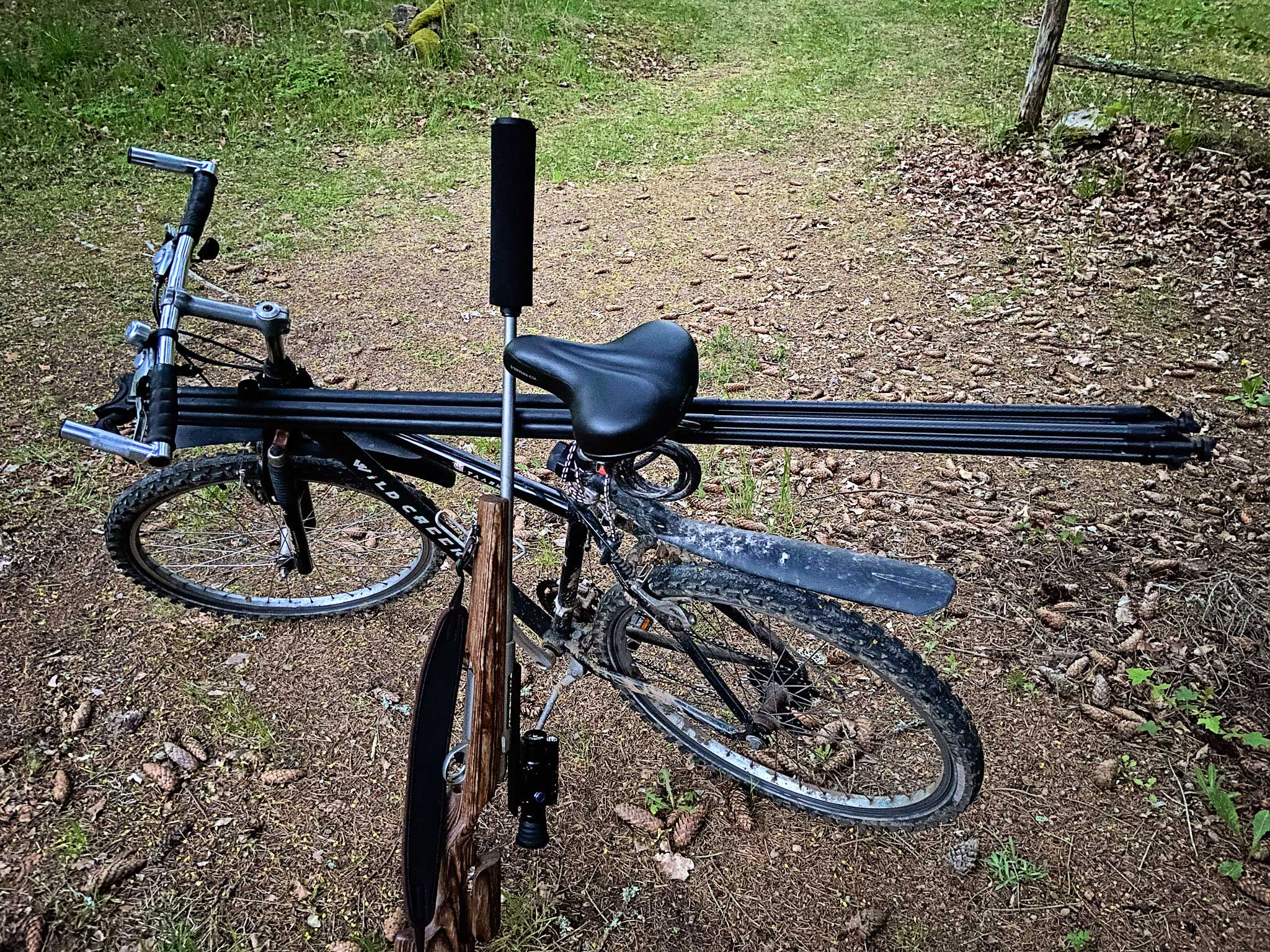
I waited ten minutes, found him, and cycled back to fetch the car. At the field edge I glanced back one last time — and was startled to see a large shadow come out of the forest and down into the wheat.
The big boar
"As an old blacksmith, you know to strike while the iron is hot — so I laid the bike down again. The boar had walked in right where I'd just been, and now I knew the ideal approach. I crept in along the same tram line and set the stick up in exactly the same spot."
Boar number three
This one showed more boar above the wheat — a bigger animal than the first. The range was 120 metres, and though it had grown lighter I lit the lamp again. He fed to the left, so I simply mirrored the last shot. Another clear strike told me it was a solid hit. I left the Viper-Flex standing at the field edge as a bearing, cycled home for the car, and waited for full light before going in — this boar was markedly bigger, and my head torch had run flat.
He had laid himself down, by a stroke of "pig luck," exactly where the recovery was easiest. And he was a true adult — a pair of tusks jutting from his lower jaw the like of which I had never seen. Back home the scale read 92 kilograms; the big one's tusks measured over 20 centimetres, the "little" one's 13. There was clearly something for the wall.

The second night
After a couple of hours' sleep, dealing with the windows and boiling out the trophies, I set the alarm for half past two and went back out. At the green strip a familiar outline stood in the wheat — boar number three, in the same dangerous corner as the others. I crept in to 112 metres and set up the stick. The scope was murky even as day broke, but the IR lamp brought him up. He trotted about, smaller than the first two, then turned broadside. I aimed low in the wheat, where the vitals were, and squeezed. He bolted right and tumbled after a few metres. It was 03:15. A young boar with little in the way of tusks, so they were left in when I delivered him.
The last night
By now I was thoroughly worn — several nights of hunting had caught up with a body no longer used to hard physical work. So I slept without setting the alarm, and again the next night, letting fate decide: if I woke at a sensible hunting hour, I would go. I woke at two, anything but fresh, but a deal with yourself is a deal.
The fourth shot
Soon I stood in the potato field with a gentle breeze at my back. I looked across towards the wheat, a kilometre and a half away — and just then a shooting star fell, straight down over that very ground. There is, as they say, more between heaven and earth, so I turned the bike. I spotted a large shadow up by the wood. It was a good 200 metres and more, so I worked in along the curved tram line. In place of my head torch I had pulled on a beanie with a built-in light, and I had brought the rangefinder. At 134 metres I judged everything was as it should be. He stood broadside, feeding on the ears of wheat. It doesn't get better than this, I thought, and pressed.
The strike that came back was markedly different from the three before, and the boar sprinted off out of my view. What have you done now? was my first thought. It is extraordinary how your confidence can turn — ready to shoot, it stands like the Eiffel Tower; with the animal gone from the spot, it feels like a balloon with the gas let out.
The search
There was nothing to do but wait for light. I went over the shot again and again — I was sure it had broken cleanly, but a different strike and a vanished boar pulled the other way. I searched the ground minutely. There — was that blood? It was: pink, clotted, a very good sign. I had the direction, and the traces led me on until I found a very dead boar. The shot sat 100 % where I had aimed.
Back by the house I found the answer. One of the seals from my ear defenders lay on the ground — it had fallen off when I fitted them under the beanie. That was why the shot had sounded so loud and the strike so different. My tinnitus had gone wild, but there was no time for that. The boar weighed just under 100 kilograms, and the drag to the road was over 250 metres.
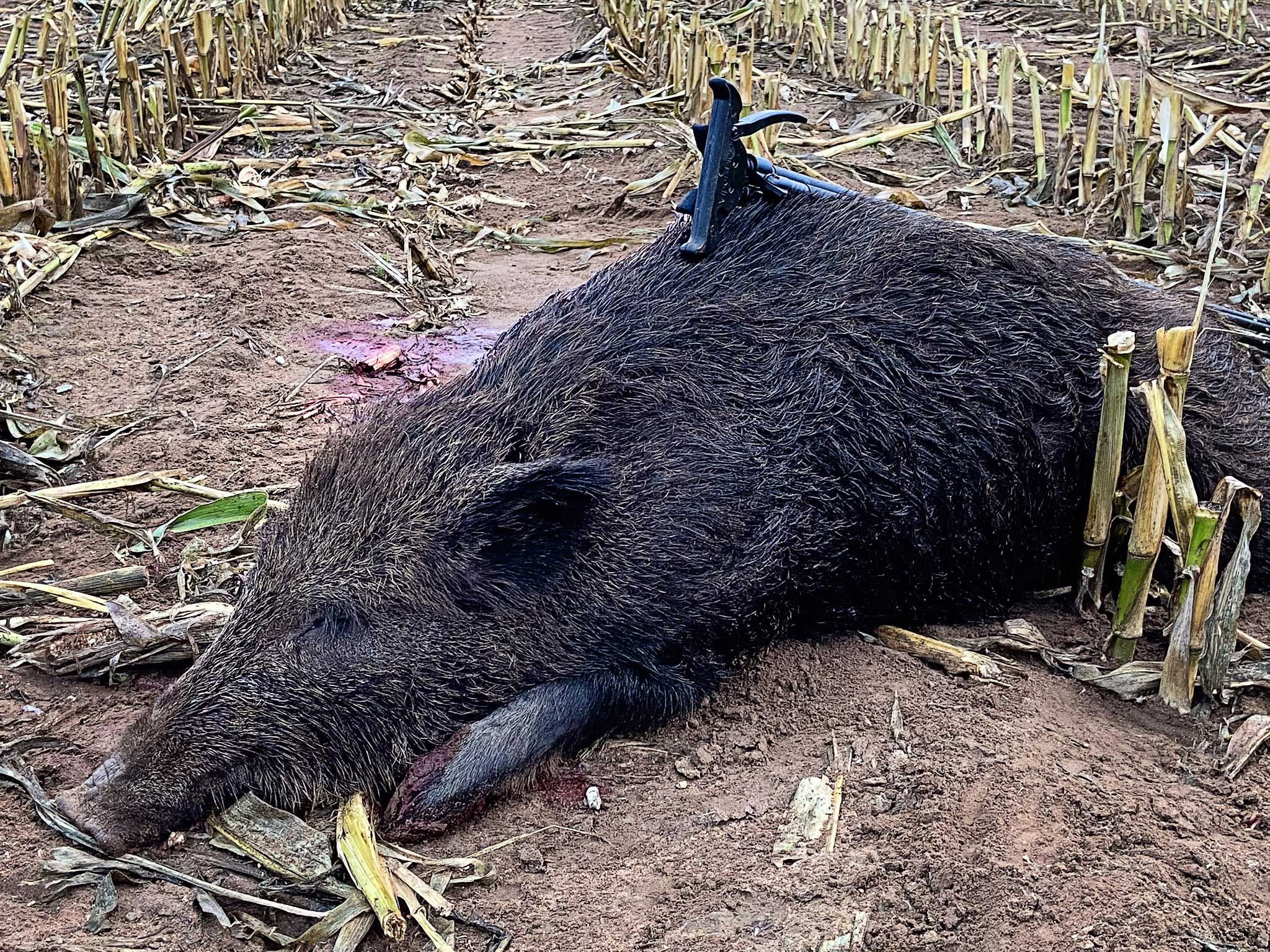
Four boars, three nights
Four wild boars over three nights, working alone with a thermal spotter, a suppressed rifle and an IR lamp. No high seat, no bait station — just fieldcraft, patience and a stable platform in the dark. On the first night I left the Viper-Flex standing in the wheat as a bearing, so I could find my way back to the boar in the dark. And it was on the stick that every one of those four shots was made.
Hunting Journal — England
Fast shots in head-high crops, buck fever at full pressure — roe bucks, summer 2023
Read the hunting journal →Rated Excellent on Trustpilot
Professional hunters worldwide
What the experts say
We have seen the success rate increase with 70% and the reduction of wounded animals with 50-60%, since we started using the Viper-Flex shooting sticks.
John Fenton
Professional Outfitter — Wicklow Mountains, Ireland
Just amazing shooting sticks to use out in the field. We use the Viper-Flex daily on safaris here in South Africa. I personally have seen reductions of wounding shots by up to 60% since we started using the Viper-Flex. Thoroughly tested and approved in the bush and mountains of South Africa.
Bjørn Georg Jensen
Professional Hunter — Side by Side Safaris, South Africa
During my 40 year career as a professional hunter, I can honestly say that this product has revolutionized both my personal hunting experience and that of our clients. I have travelled with my Viper-Flex sticks to Abu Dhabi, Burkina Faso, Ukraine, Namibia, Siberia, USA, Mongolia, Australia and New Zealand.
Dempsey Bayly
Dangerous Game Professional Hunter — South Africa
In Africa sometimes your first shot is the only chance you get to make it count. Viper-Flex sticks are truly game changing, and we have seen a substantial increase in first shot success from our clients. Do yourself a favor and order a pair!
Holger Krogsgaard Jensen
Professional Hunter — Jensen Safaris, South Africa
In the first season of integrating the Viper-Flex shooting sticks within my hunting kit, I have cut down on 80% less wounded animals. Once you have tried and used the Viper-Flex system, all other shooting sticks become obsolete.
Marius Burger
Professional Hunter — Mopani Hunting Safaris, Namibia
A guide to the hunt
Wild boar hunting in Sweden
A recent arrival in the Swedish landscape
Wild boar were absent from Sweden for the better part of two centuries. They returned in the 1980s, escaped from private collections, and have since spread across the southern half of the country at a pace nobody expected. Today the population sits somewhere around 300,000 animals, and farmers in Skåne, Småland and Östergötland have come to regard them as the most damaging game species on their land. Where roe deer might trim a few rows of wheat at the field edge, a sounder of boar can flatten an acre in a single night.
Why Swedish boar are hunted at night
Wild boar in Sweden are almost entirely nocturnal — not by nature, but by adaptation to pressure. By day they hold tight in dense forest cover. By dusk they begin to move, and by the small hours they are out in the standing crops. That is why serious Swedish boar hunters do their work between midnight and first light, with a thermal spotter, a suppressed rifle and infrared illumination on the scope. The high seat over a bait station has its place, but the more interesting hunting is on foot in the crops — reading the wind, walking the tram lines, and putting the rifle on game at distances that would not be possible without modern thermal and night vision kit.
Why a stable rifle rest matters more here than anywhere
Boar do not present themselves like deer. They come fast through standing wheat, often visible only from the shoulders up, and the broadside window can last seconds. A wounded boar in dense cover at night is the worst outcome a hunter can engineer for himself — difficult to follow up, hard on the dogs, and a poor reflection on the discipline. The shot needs to land where it is aimed. That is where a set of shooting sticks earns more than its price. A quad-leg rest, deployed quietly in a tram line, holds the rifle steady through the breathing and the heart rate that come with the moment. The crosshair stays on the shoulder. The shot goes where it is supposed to.
Working alone, without bait or high seat
The journal above describes four boar taken over three nights, hunted on foot in the standing crop, without bait and without the use of a high seat. It is a demanding way to hunt boar — harder than sitting over feed, more rewarding when it comes together, and almost entirely dependent on the kit. A bicycle to move between fields without sound. A thermal spotter to find the heat signature in the crop. A suppressed rifle so the second shot is still possible. And a shooting stick that opens silently, holds the rifle through the trigger pull, and stands as a bearing in the crop to mark the spot when the shot is done. The Viper-Flex® is the rest in all four shots described.
Planning a Swedish boar hunt of your own? Browse the Viper-Flex® range — or read the journal above to see how the sticks performed across three nights in the wheat.
Explore further
Buck Fever and the Ethical Shot
Adrenaline, wounding and the path to a steady shot
Read the article →All hunting journals
More stories from the field — Ireland, Sweden and England
See all journals →Viper-Flex® shooting sticks
Two-point support, operated with one hand — see the full range
See the shooting sticks →