
all you need before you buy
How to choose
shooting sticks
What to look for — and why it matters in the field
Buyer's guide — Shooting sticks
Shooting sticks for hunting — the complete guide
A practical guide for rifle hunters — what are shooting sticks? Why do they make a difference? Which types are there? And what should you look for before you buy?
Rifle hunters experience buck fever
Trembling hands, racing pulse — at the moment that matters mostImprovement in shot success
Reported by professional outfitters in South AfricaSingle-handed operation matters
On a stalk or driven day, the other hand is always busyWhat are shooting sticks?
Shooting sticks are a portable rifle rest. They support the rifle at the moment of the shot, giving the hunter a stable platform without the weight or bulk of a bench rest. Used for rifle hunting in nearly every part of the world, they come in a range of configurations: one leg (monopod), two legs (bipod), three legs (tripod), and four legs (quad sticks).
Most shooting sticks are height-adjustable, so the same set can be used for standing, kneeling and sitting shots. The right configuration depends on how you hunt, where you hunt, and how quickly you need to be ready to shoot. Browse the full range of shooting sticks to see how different designs are built for different situations.
Why hunters use shooting sticks
Most missed shots are not the fault of the shooter. They are the result of stress in the moment of truth. The pulse climbs, the breathing changes, the adrenaline takes hold — and the crosshair starts to move uncontrollably. Hunters call this phenomenon buck fever, and almost everyone gets it. Decades of experience can reduce it, but mostly never remove it.
A stable rifle rest does not stop buck fever. What it does is to anchor and stabilize the rifle while the body is working negatively against the shot. The hands can shake; the breath can be uneven — but the crosshair still remains on the quarry's shoulder. That is the difference between a clean kill and a wounded animal that jumps off into cover. For the ethical hunter, that difference is the whole point. See real hunts in the field where shooting sticks made the shot possible.
Bipod, tripod or quad sticks — which type is right for you?
The number of legs is the single biggest design decision in shooting sticks, and each configuration has its place in the field.
Bipod (two legs)
A bipod offers fast deployment and good stability for prone or sitting positions. It is the lightest of the three and the easiest to carry on long stalks. The trade-off is rifle movement — with only one point rest for the rifle and two points of contact on the ground, the rifle can still pivot side-to-side and up and down when the shot is taken.
Tripod (three legs)
A tripod is situated between the bipod and the quad in both stability and weight. It works well as a glassing platform and for kneeling or sitting shots, but rarely matches the rock-steady feel of a four-leg rest at the standing position. If the tripod is equipped with a "hog-saddle" you will of course get a better stability, but this requires a thick, heavy construction, instead of a slim set of sticks.
Quad sticks (four legs)
Quad sticks give the most stable platform a hunter can carry. Two points of contact on both the front and rear of the rifle and two on the ground remove almost all horizontal and forward-and-back movement. For standing and kneeling shots — the positions most hunters take in real-world conditions — a quad rest comes closest to the steadiness of a bench rest. The trade-off is weight and a slightly slower deployment than a bipod.
Not sure which configuration fits the way you hunt?
Take the 2-minute model quiz →What to look for when buying shooting sticks
Once you have decided on the number of legs, six things separate a good set of shooting sticks from a poor one. Use this list as a checklist when comparing models.
Stability
Two points of contact beats one. A four-legged rest reduces horizontal movement in the moment of the shot — and that is where most shots go wrong. The wider the cradle, the more area you can cover without repositioning.
Single-handed operation
On a driven day or a stalk, two hands is one too many. The right sticks open with one hand while the rifle stays in the other. If deployment costs you the shot, the sticks aren't working for you.
Silent legs
Rubberised legs grip soft ground, damp noise from surfaces and forest floors — and they don't announce you. In a silent wood, that distinction is the difference between a shot and an empty morning.
Durability and repairability
Sticks that can't be repaired are on a countdown. Ask before you buy: can parts be replaced individually? Is there a service behind the product? Will the manufacturer still support them in five years?
Packability — if you travel
Models that break down into sections under 65 cm fit inside a suitcase, longer sticks in a standard rifle case alongside your gun. You won't know how much this matters until the first time you have to leave your sticks behind.
Weight vs. ruggedness
Carbon-fibre sticks save weight on long stalks. Aluminium is heavier but more affordable and just as durable. The right material depends on whether you fly to your hunts or stay close to home.
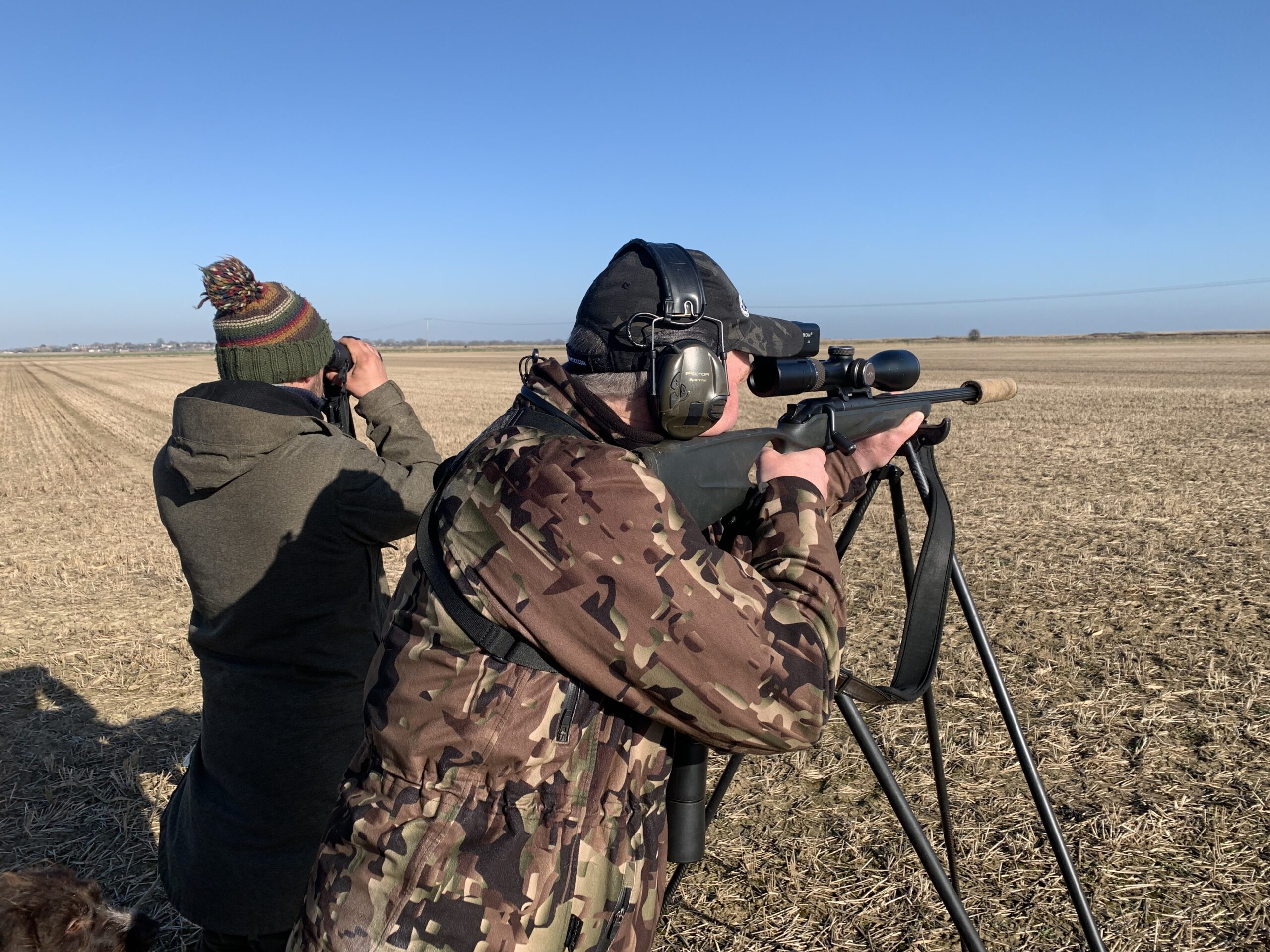
Shooting sticks for different types of hunting
Not all hunting demands the same kit. A driven shoot, a stalk in the woods, an evening in the high seat and a stalk on the African plains each put different demands on a rifle rest. Below, we look at the four main hunting situations and what to look for in shooting sticks for each.
Driven game
On a driven day, shots come fast. Animals move at speed, often through cover, and there is no time to plan the position. A simple, quick-to-deploy stick with a wide cradle is what counts. Rubberised legs help keep you quiet on the stand. Single-handed operation matters here more than anywhere — the rifle stays in your shoulder while the sticks open in the top and together by the ground. For driven shoots, the Styx Elite+ is built for exactly this work.
Stalking and mountain hunting
Stalking demands patience — and when the moment finally comes, the shot must count. A four-legged rest gives the steadiest platform for the long-anticipated shot. For hunters who travel by airplane to their stalk, packability is decisive: a stick that breaks down into a suitcase is the only practical choice. The Styx Journey+, the Journey+ XL and Styx PRO TO GO were designed and built for travelling stalkers.
High seat hunting
In the high seat, you wait — sometimes for hours. When the animal finally appears, the body has stiffened and the hands shake from cold or adrenaline. A compact rifle rest that gives the rifle a fixed platform takes the strain out of the moment — so you can focus on the crosshair, not on holding the rifle still. The Styx PRO TO GO is purpose-built small and ideal for high-seat shooting, if it has a big platform.
Safari and overseas hunting
Hunting abroad puts a different set of demands on your kit. Shots are often longer. Ground is unfamiliar. Some of the game species are dangerous. Maximum stability is the priority — with one configurable stick that can adjust between standing, kneeling and sitting positions as the country and the hunting require. The Styx Journey+, the Journey+ XL and Styx PRO TO GO, in full carbon fibre, are the models designed for hunters who travel by airplane.

The fifth leg
A Single Leg accessory converts a quad rest into a five-legged rest. Without it, you have a stable platform. With it, you have something closer to a bench rest — in the field.
Used at longer distance, on uneven ground, or when there is only one chance to get the shot right. See compatible Single Leg attachments →
About Viper-Flex®
Viper-Flex® was built in Denmark by hunters who couldn't find the sticks they wanted. Not designed at a desk — developed in the field, season after season, shaped by the hunters who use them. Still made in Rønnede, Denmark. Danish design, Danish craftsmanship, used on five continents.
Every component can be replaced. Service doesn't stop when you check out. Wooden sticks in 1985. The first four-legged design in 2008. Carbon fibre in 2022. Each generation built on what the field demanded — read the full Viper-Flex® story.
"We have seen the success rate increase with 70% and the reduction of wounded animals with 50–60%, since we started using the Viper-Flex® shooting sticks." — John Fenton, Professional Outfitter, Wicklow Mountains, Ireland
Quick answers
Frequently asked questions
The four questions hunters ask most often before they buy.
Are shooting sticks worth it?
For most rifle hunters, yes. A stable rifle rest compensates for the natural tremor that comes with breathing, pulse and adrenaline at the moment of the shot. Shooting sticks reduce wounding shots and increase the chance of a clean kill — for hunters of every experience level.
What's the difference between bipod, tripod and quad sticks?
A bipod has two legs and works well in prone or sitting positions. A tripod has three legs and offers mid-level stability. Quad sticks (four legs) provide the most stable platform for standing and kneeling shots — the positions most rifle hunters use in the field.
Can I take shooting sticks on a plane?
Yes, but it depends on the model. Sticks that disassemble into sections under 65 cm fit inside a standard rifle case. Models designed for travel — like the Viper-Flex® Journey+ and Styx PRO TO GO — pack down small enough for international hunting trips.
How tall should my shooting sticks be?
Most quality shooting sticks are height-adjustable so they suit hunters between roughly 1.65 m and 2.10 m. The full length should bring the rifle to your natural shoulder position when standing — not so high that you stretch, and not so low that you stoop.
Find the right sticks for your hunt
Browse the full range, or take the 2-minute quiz to find the model that fits the way you hunt.